


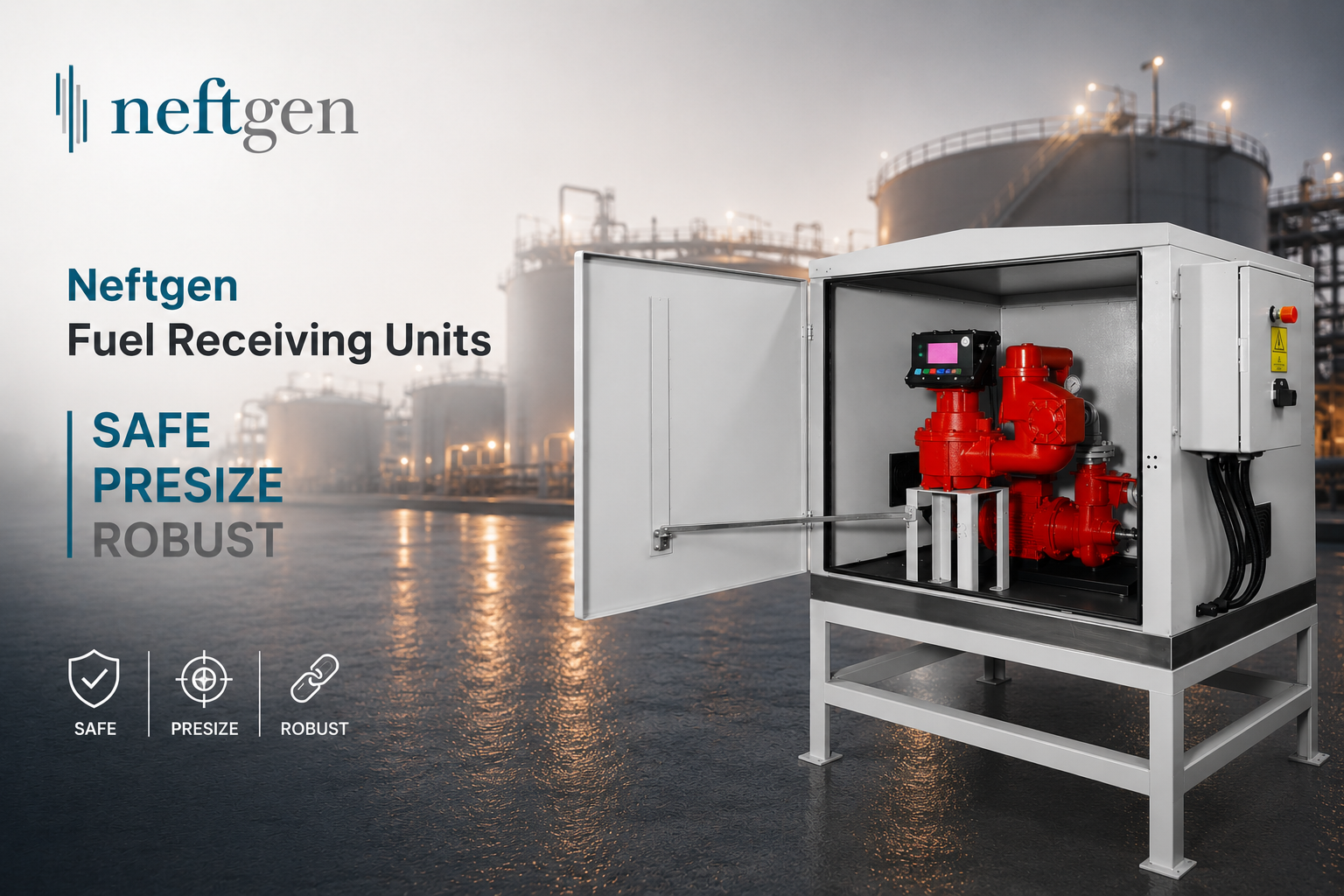
A Neftgen fuel decanting unit unloads diesel from road tankers into your storage tanks and measures every litre on the way in. It is a factory-built, factory-tested skid: explosion-proof pump, MID-approved positive displacement (PD) flowmeter, safety relief valve, high-level shutdown and Modbus RS485 communication, all under a weather canopy on a steel frame. You connect the tanker hose, press start, and the unit does the rest.
We build decanting units for data centres, power plants, fuel depots, mines, ports and any site that receives fuel by tanker and needs to know exactly how much was delivered.
Key specifications
| Hazardous area compliance | Designed to ATEX Directive 2014/34/EU. All electrical and mechanical components are ATEX-certified. |
| Pump | Explosion-proof GMP pump with Ex motor |
| Flowmeter | Positive displacement (PD) meter, ATEX and MID approved |
| Legal metrology | MID certified meter, OIML-compliant (suitable for custody transfer) |
| Flow rate | Up to 700 L/min (42 m³/h) |
| Communication | Modbus RS485 to BMS, SCADA or PLC |
| Overfill protection | High-level alarm from the receiving tank stops the pump automatically |
| Pressure protection | Safety relief valve protects pump and pipework against a closed discharge |
| Construction | Steel skid frame with canopy roof and side protection, ready for outdoor installation |
What is a fuel decanting unit?
“Decanting” means transferring fuel from a delivery tanker into a fixed storage tank. Many tankers arrive without their own pump, or the site does not want to rely on the driver’s equipment. A decanting unit (also called a tanker unloading skid or fuel receiving unit) gives the site its own controlled, metered unloading point.
Three things matter at that point: safety (diesel vapour, static, hose failure, overfilling), accuracy (paying only for the fuel you actually received) and control (the operator and the building management system should see what is happening). A good decanting unit solves all three in one skid.
How it works
- Connect. The tanker hose is coupled to the unit’s inlet. The skid is earthed and the tanker is bonded before transfer starts.
- Start. The operator starts the pump from the local panel. The pump draws fuel from the tanker and pushes it through the PD meter towards the storage tank.
- Measure. The PD meter counts the delivered volume. Because it is MID approved, the reading can be used for invoicing and stock control.
- Protect. If the storage tank reaches its high level, the level alarm stops the pump. If a valve downstream is closed, the relief valve opens and protects the pump and piping.
- Report. Totals, pump status and alarms are sent over Modbus RS485 to the site BMS or SCADA, so the delivery is recorded without manual notes.
Project: fuel decanting unit for a data centre in Tashkent, Uzbekistan
A new data centre in Tashkent needed a reliable way to refill the bulk diesel tanks that feed its backup generators. Fuel arrives by road tanker. The operator had three requirements: unload quickly, never overfill a tank, and have a delivery record that matches the supplier’s invoice.
Neftgen designed and built a skid-mounted decanting unit for this site:
- Speed: at up to 700 L/min, a 30,000 litre tanker can be unloaded in about 45 minutes of pumping time, so the tanker spends less time on site.
- Billing accuracy: a MID-approved PD flowmeter measures each delivery. The data centre checks the delivered volume against the invoice instead of relying on tank dips.
- Overfill protection: the high-level alarm of the receiving tank is wired to stop the pump. An operator error cannot overflow the tank.
- Integration: delivery totals and alarms go to the facility BMS over Modbus RS485, so fuel stock and every delivery are visible in the control room.
- Hazardous area: the complete unit follows ATEX 2014/34/EU. Pump, motor, meter and electrical parts are all ATEX-certified.
- Climate: Tashkent has hot summers and freezing winters. The canopy and steel frame protect the pump, meter and panel from sun, rain and snow.
For a data centre, fuel is the last line of defence when grid power fails. The decanting unit is the part of the fuel system that keeps that reserve topped up. It works together with the bulk tanks, generator day tanks and transfer pumps that Neftgen supplies for data centre fuel systems.
Where decanting units are used
- Data centres and hospitals: refilling bulk tanks for backup generators
- Power plants: receiving diesel or light fuel oil for gensets and start-up systems
- Fuel depots and distributors: metered unloading into storage
- Mining and construction: fast tanker unloading at remote sites, often combined with a mobile fuel station
- Ports and airports: receiving fuel for ground equipment and vessels
What we need to size your unit
Flow rate alone is not enough to select a decanting unit. To design the right skid we look at:
- Fuel type: diesel, kerosene, heavy fuel oil or gasoline. Viscosity and vapour pressure change the pump and the hazardous-area design.
- Target unloading time and typical tanker size.
- Suction conditions: tanker outlet height, hose length and the distance from the unit to the storage tank. These decide pump head and suction capacity.
- Custody transfer needs: when the tanker runs empty, air can reach the meter. For legal-for-trade measurement we add a gas/air eliminator and strainer upstream of the meter.
- Tank instrumentation: how the high-level signal is provided, and whether you want a batch preset (stop at a set volume).
- Control system: Modbus RS485 is standard. Other protocols or a local PLC/HMI with printer can be added.
- Site: hazardous-area zone classification, power supply, ambient temperature and installation space.
Frequently asked questions
What is the difference between a decanting unit and a metering skid?
A decanting unit is a metering skid built specifically for tanker unloading. It includes the pump, meter and protections needed to receive fuel into storage. A general fuel pumping and metering skid can also be used for loading, transfer between tanks or dispensing.
Why use a PD flowmeter?
Positive displacement meters measure volume directly and stay accurate across the viscosity range of diesel and similar fuels. With MID approval, the reading is accepted for billing.
Can the unit stop automatically at the right volume?
Yes. The pump always stops on the storage tank’s high-level alarm. A batch preset that stops at a fixed volume can be added with a batch controller or PLC.
Can it connect to our BMS or SCADA?
Yes. Modbus RS485 is standard and carries delivery totals, pump status and alarms. Other protocols can be supplied on request.
Is the unit tested before shipment?
Every unit is assembled and tested in our factory before delivery. Commissioning support on site is available.
Request a quote
Send us your fuel type, target flow rate, tanker size and site location. We will reply with a proposed configuration and price. You can also reach us on WhatsApp, by phone at +90 212 813 66 00 or at info@neftgen.com.